
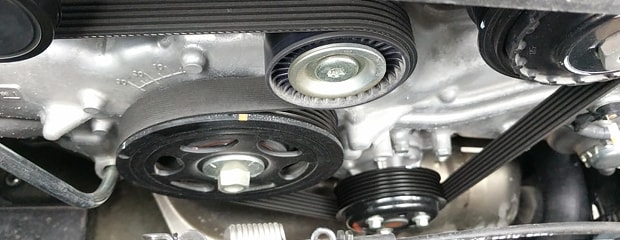
 Has your engine ever backfired, raised a racket with clanging noises or just plain broke down? The culprit might be a bad timing belt. How does this one small component have such a powerful effect on a vehicle's engine? Our seasoned automotive techs here at Shell Rock, IA Roling Ford gave us a quick overview to answer this question.
A timing belt keeps engine parts moving in perfect intervals, a factor that's essential to engine efficiency. The parts in question include the engine camshafts and the crankshaft. The camshafts control engine intake and exhaust valves, ensuring they open and close at proper times. The crankshaft turns linear motion into rotation, contributing to wheel torque.
Other Timing Belt FeaturesIn some vehicles, the timing belt may even drive the shaft of the water pump. The belt attaches to all the shafts via differently spaced cogwheels. The differently spaced cogwheels cause the ease shaft to rotate at a different speed, preserving the precise timing that's necessary for a healthy, working engine.